
How a digital strategy consulting firm fixed process chaos
Digital Prism Advisors, a digital strategy consulting firm, evaluated dozens of workflow tools and chose Tallyfy for its balance of power and simplicity over manual ad-hoc processes.
Summary
- Former C-level executives chose functionality over complexity - Digital Prism Advisors evaluated dozens of workflow tools and selected Tallyfy because it balanced powerful features with ease-of-use, not requiring weeks of training or IT support
- Manual ad-hoc processes created quality risks - Without documented workflows, critical steps in onboarding, contract approvals, and contractor management were getting missed or done out of order, threatening service quality
- Written processes eliminate mistakes - Forcing the team to document workflows in Tallyfy ensured steps weren’t skipped and tasks happened in the correct sequence, resulting in fewer errors across operations, finance, and account management. See how Tallyfy helps consulting firms
Digital Prism Advisors - A New York based digital strategy consulting firm (now part of Mod Op) helping medium to large organizations grow through effective use of data and digital capabilities. Their team is comprised of highly respected former C-level operating executives who chose Tallyfy because of its functionality and ease-of-use.

Len Gilbert
COO
Digital Prism Advisors
Why process chaos is a consulting firm’s worst enemy
Here’s a truth that keeps biting digital strategy consulting firms:
I’ve watched this play out over and over. A consulting firm lands a big engagement, hires smart people, does great work - and then things start slipping. Steps get missed. Approvals get bottlenecked. Somebody forgets to run the onboarding checklist. The service quality that won the deal starts eroding because nobody wrote down how things should actually work.
Gartner’s research keeps confirming what we’ve seen firsthand - the majority of AI and automation projects fail not because the technology is wrong, but because the underlying processes are broken. You can’t automate chaos. You just get faster chaos.
Digital Prism Advisors ran straight into this wall. Their team of former C-level executives knew how to advise Fortune 500 companies on digital transformation. But internally? Their own processes were manual, ad-hoc, and dependent on whoever happened to remember the next step.
Workflow Automation Software Made Easy & Simple
Tallyfy has the best combination of functionality and ease-of-use
- Len Gilbert, COO, Digital Prism Advisors
What Digital Prism Advisors needed to solve
Len Gilbert, their COO, put it simply: they wanted processes in place for key regular functions that multiple people could access. They needed to track routine processes and make sure things got completed on time.
That sounds basic. It is basic. And that’s exactly why so many consulting firms get it wrong - they assume smart people don’t need structure. In our experience at Tallyfy, the opposite is true. The smarter and more senior your team, the more they benefit from documented workflows. They’re juggling too many things to rely on memory.
Professional services firms make up roughly 10% of the conversations we have about workflow automation. The pattern is always the same: brilliant people doing brilliant work, held together by tribal knowledge and inbox searches. It works until it doesn’t. And when it stops working, it stops working fast.
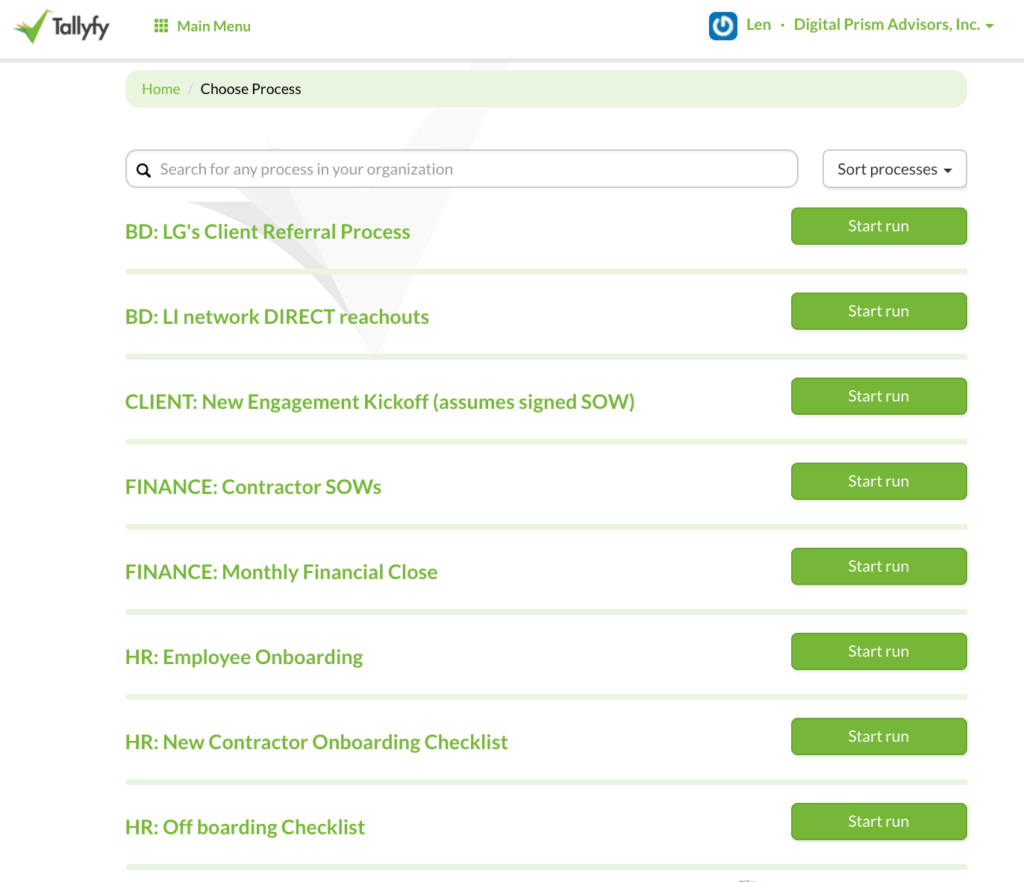
The processes they run on Tallyfy
Digital Prism Advisors moved everything into Tallyfy. Not just one process or one department - the whole operation:
Business development
Referrals for digital strategy consulting engagements
Engagement-related
Account kick-offs
Contract and SoW approvals
Human resources
Contractor onboarding and offboarding
Templates for consulting firms
Before Tallyfy, all of these ran manually and on an ad-hoc basis. No documentation. No tracking. No way to know if somebody skipped a step until the damage was already done.
Why they picked Tallyfy over dozens of alternatives
They evaluated dozens of applications. Dozens.
That’s not unusual for consulting firms, by the way. In discussions we’ve had with operations leaders at professional services firms, the typical evaluation cycle covers 15-25 different tools before narrowing down. The firms that prioritize ease-of-use alongside functionality tend to see much higher adoption rates within the first 90 days.
Len’s team landed on Tallyfy because it had the best combination of functionality and ease-of-use. That matters more than most people think. A tool that’s powerful but takes three months to learn is worse than useless in a fast-moving consulting environment. People just won’t use it. They’ll revert to email and spreadsheets within a week.
This is something we built Tallyfy around from day one - the idea that you shouldn’t need IT support or weeks of training to document and track a process. Sixty seconds to learn, not six months of IT projects. That philosophy is what wins over teams full of senior executives who have zero patience for clunky software.
What changed after switching to documented workflows
By forcing themselves to write out their processes, Len’s team could finally ensure that steps weren’t missed or done out of order.
His exact words: “Generally, there are fewer mistakes.”
That might sound underwhelming. It’s not. Fewer mistakes in a consulting firm means fewer missed deadlines, fewer embarrassing gaps in deliverables, and fewer late-night scrambles to fix things that should have been caught three steps earlier. MIT Technology Review’s analysis found that only about 30% of organizations successfully scale their digital improvements. The rest see initial gains that fade because they lack the operational foundation to sustain them. Process documentation is that foundation. Without it, every improvement is temporary. The gains you made last quarter evaporate because nobody wrote down what changed or why. New hires repeat old mistakes because the institutional memory lives in people’s heads, not in a system. And then leadership wonders why the same problems keep resurfacing despite all the money they spent on “transformation.”
In our conversations with operations teams at similar firms, we hear the same thing repeatedly - the act of writing down a process forces you to find the gaps. Steps that seemed obvious turn out to be ambiguous. Handoffs that worked fine with three people break completely at ten. The documentation itself becomes the diagnostic tool.
The bigger picture for digital strategy firms
Len described Tallyfy this way: it helps you create repeatable processes and then makes sure your team follows them.
He recommended it for operations, finance, account management, and even sales. Basically every department that does anything more than once.
Here’s what makes this especially relevant right now. Every consulting firm is scrambling to figure out AI. They’re advising their own organizations on digital transformation while running their own operations on sticky notes and memory. The irony would be funny if it weren’t so expensive.
The firms that document their processes first - before bolting on AI or automation - end up in a fundamentally different position. They can actually use AI tools effectively because the AI has structured workflows to operate on. Without that structure, AI agents are just chatbots pretending to be useful.
We’ve observed this pattern at Tallyfy across hundreds of implementations. The firms that start with process documentation - even simple documentation - scale more smoothly than those that try to add structure after hitting chaos. It’s the difference between building a house on a foundation versus trying to pour concrete under a house that’s already built.
What this means if you run a consulting firm
I think every consulting firm with more than five people needs to answer one question honestly: if your best person quit tomorrow, could someone else pick up their work without a two-week knowledge transfer?
If the answer is no, you don’t have a process problem. You have a business risk.
Probably the most underrated benefit of tools like Tallyfy isn’t the automation or the tracking - it’s the forced clarity. When you have to write down “step 1, step 2, step 3,” you find out fast whether your process actually makes sense or whether it’s just a collection of habits that happened to work so far.
Digital Prism Advisors figured this out. They were a team of former C-level executives who’d spent careers running large organizations, and they still needed documented workflows to keep their own consulting firm running smoothly. That should tell you something.
The gap between “we know how to do this” and “we’ve documented how to do this so anyone can follow it” is where most consulting firms lose money, lose quality, and lose sleep. Closing that gap doesn’t require a massive transformation project. It requires writing things down and tracking them.
Based on hundreds of implementations we’ve seen at Tallyfy, the firms that start small - one process, one team, one week - end up with the strongest foundations. They don’t try to boil the ocean. They pick their messiest recurring workflow, document it, run it a few times, and fix what breaks. Then they do the next one.
That’s it. No six-month consulting engagement required. Just clarity, one process at a time.
About the Author
Amit is the CEO of Tallyfy. He is a workflow expert and specializes in process automation and the next generation of business process management in the post-flowchart age. He has decades of consulting experience in task and workflow automation, continuous improvement (all the flavors) and AI-driven workflows for small and large companies. Amit did a Computer Science degree at the University of Bath and moved from the UK to St. Louis, MO in 2014. He loves watching American robins and their nesting behaviors!
Follow Amit on his website, LinkedIn, Facebook, Reddit, X (Twitter) or YouTube.

Automate your workflows with Tallyfy
Stop chasing status updates. Track and automate your processes in one place.