Purchasing approvals in public agencies are a different beast. You’re not just getting a manager’s thumbs-up - you’re navigating legal requirements, public accountability, and procurement regulations that most private companies never think about. Here’s how one transit agency tackled it.
Summary
- Paper approvals that took days now complete in minutes - Alexandria Transit Company replaced ink-signature requisitions and the chaos of scanning and emailing forms with digital workflows that route purchase requests, invoice payments, and expense reports through proper approval chains automatically
- Public agency compliance is baked into every step - Complex government purchasing regulations that staff struggled to follow are now documented as step-by-step workflows in Tallyfy, pushing project managers to evaluate options properly while maintaining legal accountability to the public
- Better budget visibility without a massive ERP rollout - Directors see exactly what their departments are buying in real-time, market research happens naturally as part of the process, and purchasing compliance improved dramatically - all without the time and cost of implementing heavyweight enterprise software. See how Tallyfy works for public agencies
Approval Management Made Easy
Alexandria Transit Company (DASH) - Operates the DASH bus system in Alexandria, Virginia. DASH provides free, reliable bus service throughout the City of Alexandria, connecting with Metrobus, Metrorail, Virginia Railway Express, and all local bus systems. DASH serves all Alexandria Metrorail stations and the Pentagon station during peak periods. The system went fare-free in September 2021 and has since expanded service with electric buses and new route coverage.
Why paper purchasing approvals were failing DASH
Public transit agencies operate under strict FTA procurement regulations that require documented approval chains, competitive sourcing, and audit trails for every purchase. That’s a lot to manage on paper. DASH was trying to do exactly that - ink signatures on requisition forms, scanning, emailing, hoping the right people saw the right documents at the right time.
Evan Davis, Director of Finance and Administration at DASH, explained the situation: they’d created a new purchasing approval process that would’ve relied on paper requisitions needing ink signatures from approvers. They needed an online system for digital approvals that could also document the process for end users. The processes weren’t well documented or understood. Staff didn’t consistently follow them. That’s not a people problem - it’s a process design problem. Pay attention to this part about AI and automation that most people miss: if your approval workflow is a mess of paper forms and email threads, throwing AI at it just creates a faster mess. You have to define the process first. DASH understood this instinctively - they needed to document and structure their workflows before any technology could help. They considered using Excel spreadsheets as the backbone of the system, but spreadsheets can’t handle clear approval workflows or document attachments. They also looked at other online solutions before landing on Tallyfy because it could handle complex, custom conditional workflows - exactly what public procurement demands.
What DASH runs on Tallyfy
DASH built several workflow templates in Tallyfy for their purchasing and accounting operations:
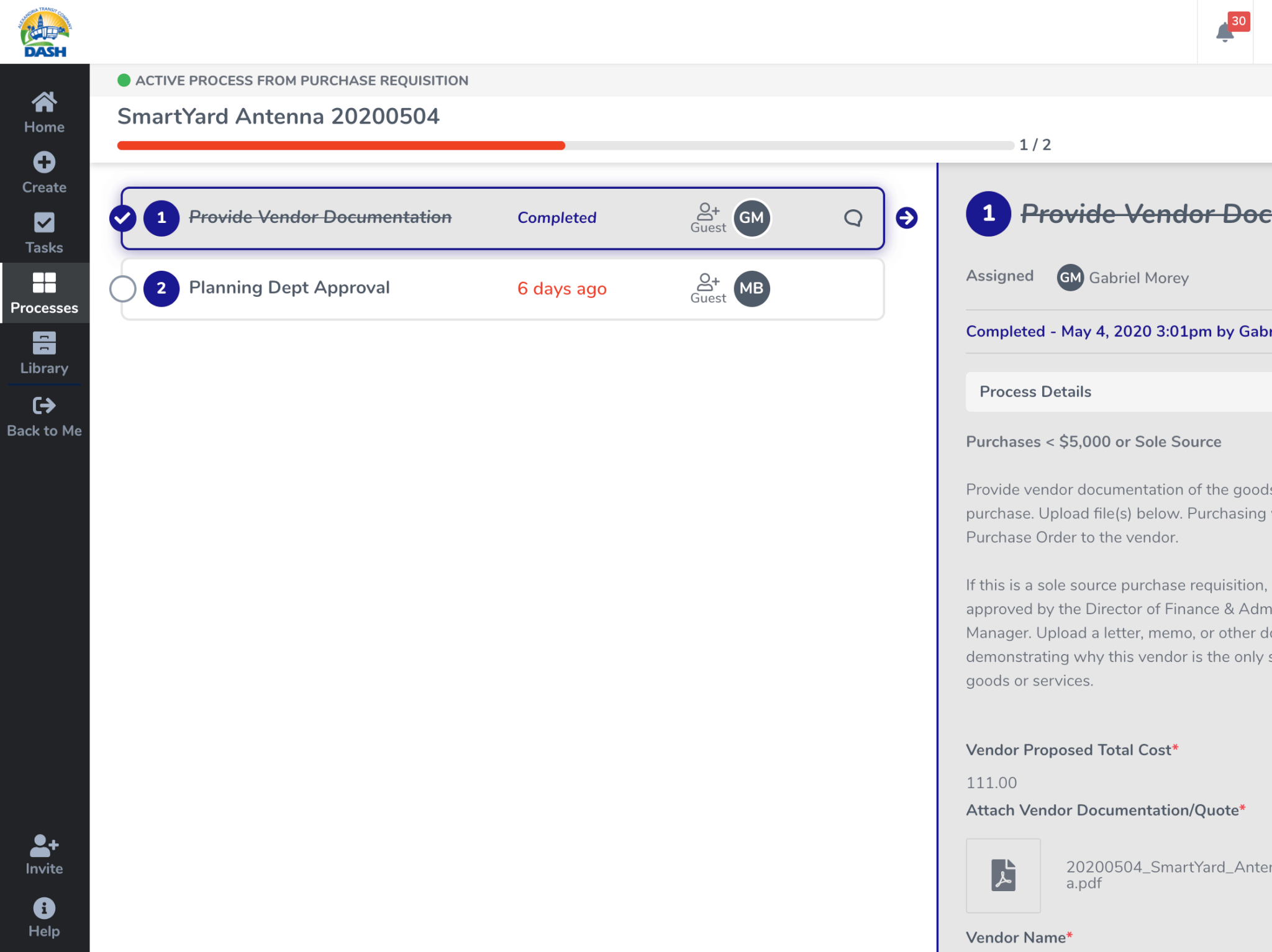
- Purchase Requisition
- Receiving Report and Invoice Payment
- PO Change Order
- Travel Expense Report
- Non-Travel Expense Reimbursement
- Conference and Training Request
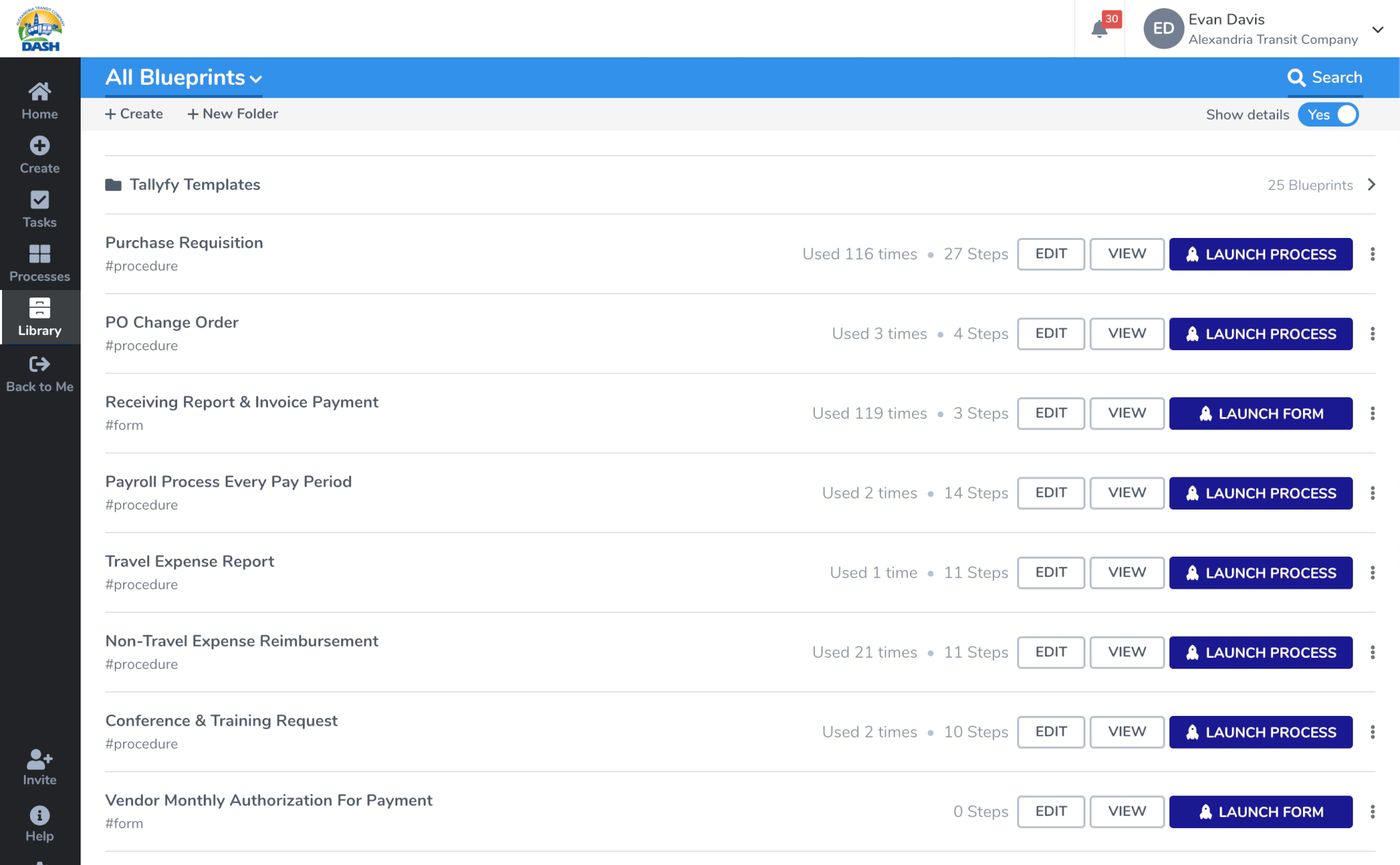
Each template captures the exact steps, approvals, and documentation requirements that FTA best practices demand. No guesswork. No “I think this is how we do it.” The process guides people through compliance automatically.
This is something we’ve seen over and over at Tallyfy. Every time we onboard a new team, the same issue surfaces - their processes exist as static PDFs that nobody reads. Once you document a process as a living, trackable workflow instead, compliance stops being a burden and starts being a byproduct of doing the work.
From days to minutes on approvals
The speed difference is dramatic. A paper-based approval could take a couple of days if someone was waiting for a director to be physically available for a signature. Now approvals often complete in minutes.
Evan acknowledged there was a learning curve initially, and DASH simultaneously increased the complexity of what they were asking the team to follow. That’s real. Most organizations won’t admit that doing things right sometimes takes more effort upfront. But the payoff compounds - every subsequent purchase flows through a proven, documented path.
Think about what that means for a public agency. Research from Precoro shows that manual procurement workflows create delays, errors, and lack of transparency - precisely the things a publicly accountable agency can’t afford. When taxpayer money is involved, “we lost the approval form” isn’t an acceptable answer.
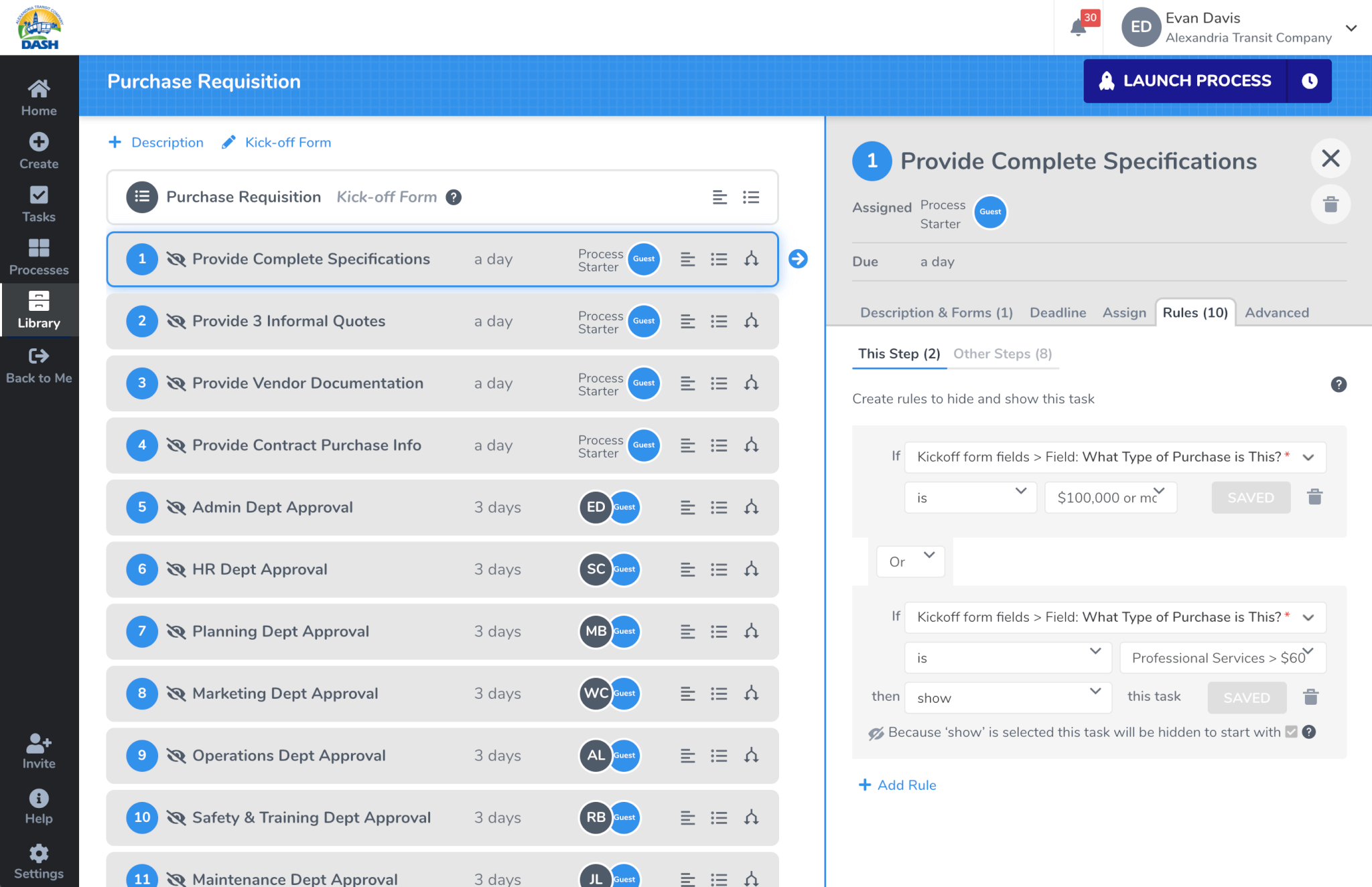
At Tallyfy, we built conditional logic specifically for situations like DASH’s. A purchase under a certain threshold routes one way. Above that threshold? Different approval chain, different documentation requirements, different compliance checks. The workflow handles the routing. People just do their jobs.
How compliance became automatic
As a public agency, DASH is legally required to follow a complex purchasing process designed to be accountable to the public. Through Tallyfy, they documented all the steps of that process to guide staff into compliance.
Here’s what changed:
Confusion and email traffic associated with integrating details from several people into each workflow dropped sharply. At the same time, awareness of each department’s spending and the purchasing process increased dramatically - leading to better market research and budget control.
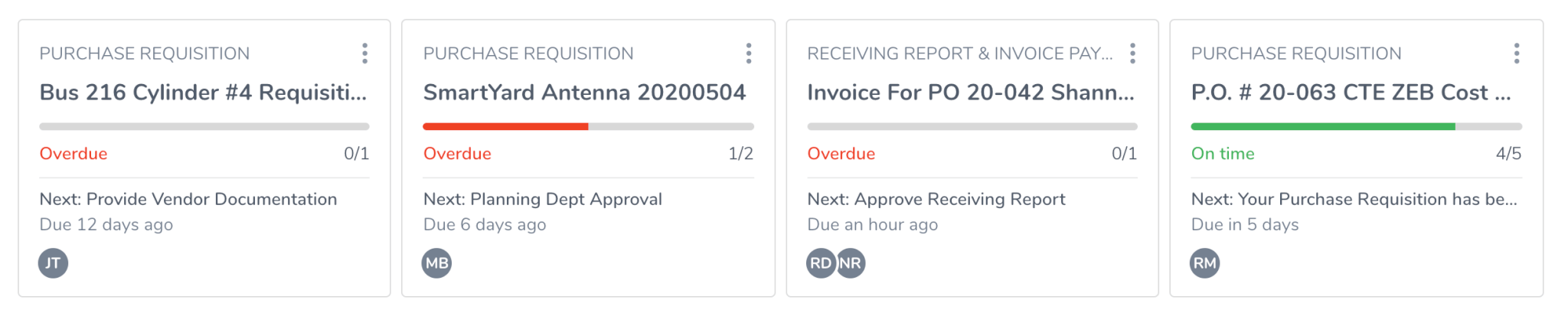
Purchasing compliance increased. Directors gained real-time visibility into what their employees are buying and why. The step-by-step process pushes project managers and buyers to take the time to evaluate several options and properly document their work.
This is worth sitting with for a second. The Federal Transit Administration’s procurement manual requires agencies to maintain written procurement procedures, conduct cost analyses for every purchase, and document competitive sourcing. DASH built all of that into their Tallyfy workflows. Compliance isn’t a separate activity - it’s embedded in how work gets done.
Are approval delays acceptable?
What busywork costs your company
per week
per year
over 5 years
What this means for other public agencies
Evan put it well: Tallyfy enabled DASH to digitize their custom processes without the time and expense of implementing a large ERP-type system. That’s a huge deal for smaller agencies.
After watching hundreds of teams try this, I probably hear this concern more than any other from operations leaders at mid-sized organizations. They know they need better processes. They know paper forms and email chains are risky. But they also know that a full ERP implementation could take 12-18 months and cost more than their entire department budget.
That’s the wrong take. You don’t need to boil the ocean. Start with one process - your most painful approval workflow - and digitize that. DASH started with purchasing approvals and expanded from there. They now anticipate adding more processes from other departments.
The features that drew DASH to Tallyfy:
- Ability to design complex, custom workflows with conditional rules
- Clean, clear user interface
- Affordable compared to software with similar capabilities
- Task assignment to specific individuals with documented approvals
- Social media-style comments on each task for collaboration
- File attachments within the workflow
Evan’s recommendation: Tallyfy works for anyone trying to affordably digitize complex workflows that don’t fit inside the box of more standardized web-based project management software. He sees value across finance, purchasing, human resources, operations, and other functions. Other small public agencies without access to heavy ERP systems may find Tallyfy a good fit for procurement workflows.
The bigger picture on process-first thinking
Everyone’s rushing to bolt AI onto their procurement workflows right now. CIO reports that AI agents could automatically validate supplier documents and route contracts for approval. That sounds great. But here’s what 74% of procurement leaders admit: their data isn’t AI-ready.
Why? Because the underlying processes are still a mess. You can’t hand an AI agent a pile of paper forms and expect magic.
DASH’s approach - define the process, document every step, build in compliance checks, then let technology handle the routing - is exactly the foundation that makes future AI adoption possible. They didn’t just fix their purchasing approvals. They built the workflow infrastructure that AI agents need to function.
That’s the real lesson here. Not “go digital because paper is slow” - though it is. The lesson’s that structured, documented processes are the prerequisite for everything that comes next. Whether that’s AI-driven procurement, automated compliance checks, or just knowing where your money’s going.
DASH got that right from the start.