
How a solo founder tamed his production process
Solo founder William van Rossum tamed his production process at Videotrails by replacing ad-hoc chaos with repeatable workflows, proving structure beats tool sophistication.
Production processes for solo founders and small teams need structure without overhead. Here’s how we approach workflow management.
Workflow Made Easy
Summary
- Solo founders juggle too many hats without a system - William van Rossum ran software development, accounting, and outreach entirely alone at Videotrails, and his production process was inconsistent because tasks happened on an “as-needed” basis with no repeatable structure
- Trello fell short on repeatability - It lacked priorities, statuses, and was never designed for processes you run again and again, which forced William into constant improvisation instead of following a reliable pattern
- Tallyfy broke big goals into visible, tiny tasks - Color-coded process bars showed status at a glance without mental effort, and flexible dates meant shifting plans didn’t cause a meltdown. William used Tallyfy to finish his 2017 accounting on time by chunking one big deadline into manageable pieces. See how Tallyfy helps small teams
Videotrails helps businesses understand precisely who watches their videos and how. Think of it as Google Analytics, but for video - showing session heatmaps, engagement patterns, and viewer behavior. William van Rossum, marketing specialist and owner, describes how Tallyfy gave him control over his entire production process and multiple internal and outreach-facing business processes.

William van Rossum
Owner & Video Marketing Specialist
Videotrails
The core problem every solo founder faces
I’ve talked to hundreds of solo founders over the years, and they all describe the same thing. Everything feels like it’s on fire, all the time. William’s situation at Videotrails was textbook. As the founder and only employee, he had to keep track of software development, accounting, and outreach - all simultaneously. There was no team to delegate to. No project manager keeping things organized. Just him, a to-do list in his head, and the hope that nothing important slipped through the cracks. His production process ran on an “as-needed” basis - which is a polite way of saying it didn’t really run at all. Tasks got done when they became urgent, not when they should have been done. The result was inconsistent output and unpredictable timelines.
This is something the IMF flagged when they wrote about why AI fails without streamlined processes - many organizations are “putting the technological cart before the process horse.” And it’s not just big enterprises. Solo founders do the exact same thing, just at a smaller scale.
Here’s the part that I think matters most: If your workflow is a mess before you add automation, you’ll just get a faster, more expensive mess. William figured this out early - he needed structure first, then tools.
Why Trello didn’t cut it
Before Tallyfy, William tried Trello. It’s a fine tool for what it does. But what it does isn’t process management.
Trello lacked two things William needed badly: priorities and statuses. When you’re managing a production process solo, you can’t afford to guess which card matters most or what stage something is at. You need that information instantly, without clicking into anything.
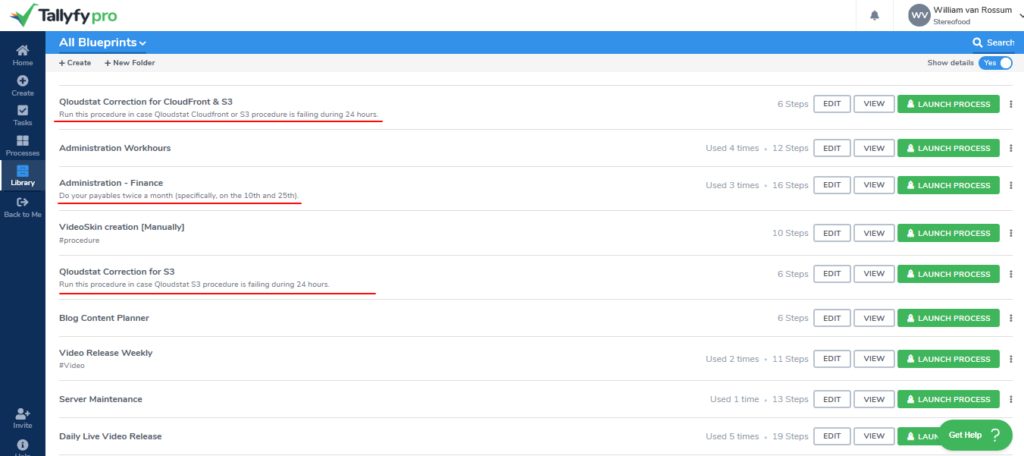
The bigger gap was repeatability. Trello isn’t built for processes you run over and over. Every time William needed to kick off the same workflow - say, onboarding a new prospect or doing monthly accounting - he’d have to rebuild it from scratch. Or worse, copy a board and hope he didn’t miss a step.
In discussions we’ve had about tool selection, this pattern comes up constantly. Teams pick project management tools when what they actually need is process management. There’s a real difference. Project management tracks unique work. Process management tracks repeatable work. Mix them up and you’ll wonder why nothing feels organized.
What else was on the radar?
William also looked at pep.cards, another process management solution. He ultimately chose Tallyfy because it had the features he needed at a price that made sense for a one-person operation. No bloated enterprise pricing. No features he’d never touch.
What changed after switching to Tallyfy
The shift was immediate. Here’s William in his own words:
Tallyfy has destressed my work environment by giving me a clearer picture of everything that is going on in my company. It has made it easier to put my plans into action by breaking things down into tiny tasks.
That word - “destressed” - comes up more often than you’d expect in our conversations about workflow tools. People don’t usually describe software as stress-reducing. But when your production process goes from chaotic to visible, the psychological relief is real.
William’s first real test was finishing his 2017 accounting. He broke that single, looming deadline into smaller tasks inside Tallyfy. Each one got a due date. Each one was trackable. He finished on time.
That might sound trivial. It isn’t. For solo founders, a single missed deadline can cascade into weeks of catch-up. Breaking goals into chunks isn’t just productivity advice from a blog post - it’s how you survive when there’s nobody else to pick up the slack.
The features that made the difference
Tallyfy’s strength for William came down to two things: simplicity and visual clarity.
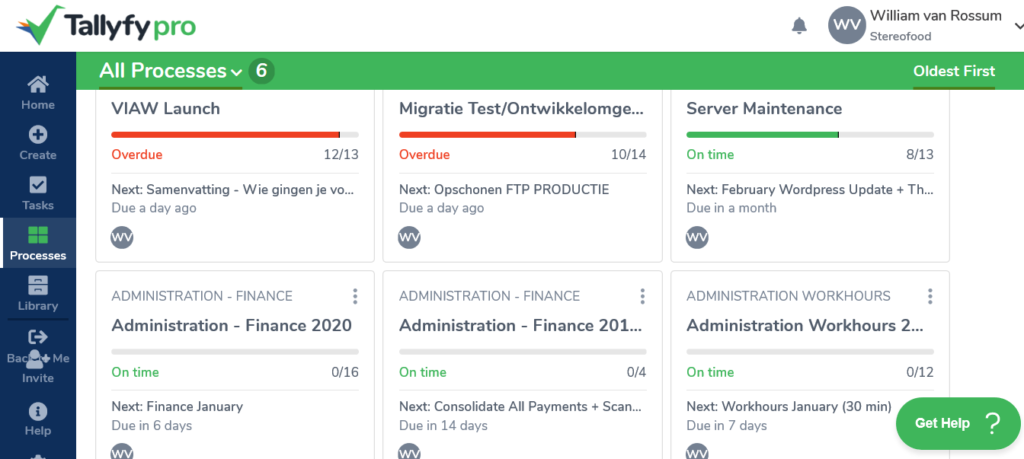
The colored process bars were his favorite. Green, yellow, red - you know where everything stands without reading a single word. He described it this way:
Colored process bars make it easy to know the status of each of my tasks, often without even needing to think about it.
That’s the goal, honestly. If you have to think about your production process to understand it, the tool isn’t doing its job. The best workflow software disappears into the background. You glance at it, get your answer, move on.
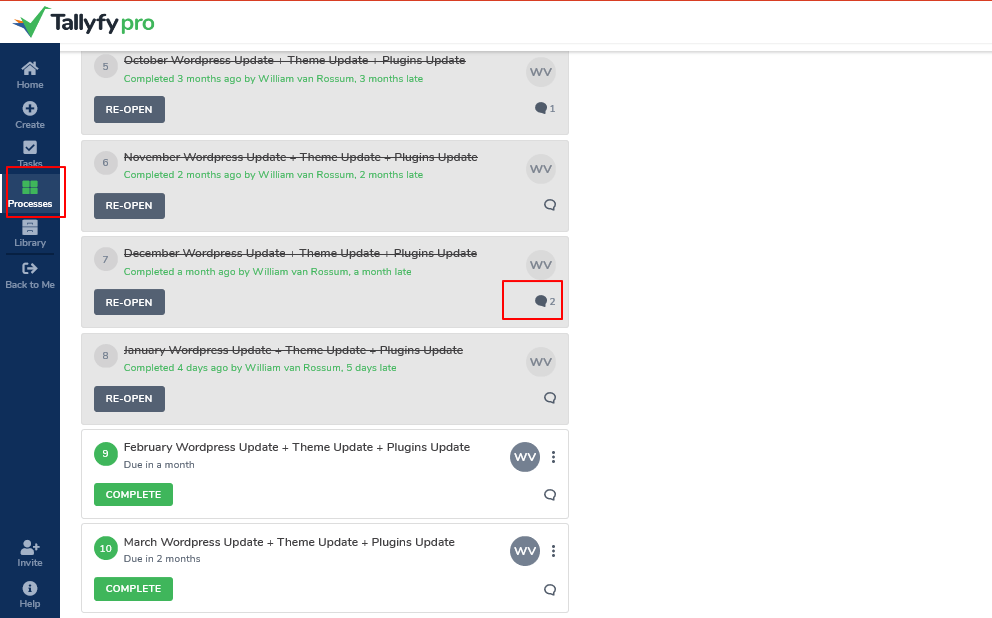
The other feature William loved was date flexibility. Plans change. Especially for solo founders. A meeting gets rescheduled, a development sprint runs long, a prospect goes quiet for two weeks. Rigid deadlines in rigid tools create anxiety. Tallyfy lets you shift dates without breaking the whole workflow.
Why process structure matters before you add AI
Here’s where this story connects to something bigger happening right now.
Everyone’s racing to add AI to their workflows. And I get it - the promise is compelling. But there’s a pattern we’ve observed across hundreds of implementations at Tallyfy: the teams that succeed with automation are the ones who already had their processes defined before they started automating.
Research from iGrafx puts it bluntly - don’t automate chaos. And research on AI adoption shows that only about 1% of organizations have the operational maturity to really make AI work. The other 99% are still figuring out their basic processes.
William didn’t use AI at Videotrails. But what he did was probably more important - he defined his processes first. He made them repeatable. He made them visible. That’s the foundation everything else sits on.
I’m not saying skip AI. I’m saying fix your process first. A structured, repeatable workflow is worth more than the flashiest automation tool money can buy. And honestly? Once you have that structure, automation becomes almost obvious. The hard part was always the process definition, not the technology.
IEEE Spectrum’s analysis shows that 40% of enterprise apps will feature AI agents by 2026, up from less than 5% the year before. That’s a massive jump. But those agents will only be as good as the processes they follow. No process? No value.
William’s take on scaling up
When asked whether he’d recommend Tallyfy to others, William didn’t hesitate:
Tallyfy is able to scale up to larger-sized teams. Even loosely connected, possibly multinational, teams can be mended together and more focused through Tallyfy.
This is worth thinking about. William started as a solo founder. But he could see how the same process structure would work for distributed teams. That’s the thing about getting your production process right - it doesn’t just solve today’s problem. It builds the rails for whatever comes next.
At the end of the day, Tallyfy gives me a feeling of control over the processes involved in my production process.
Control. Not complexity. Not dashboards with thirty charts. Just the feeling that you know what’s happening and what needs to happen next. For a solo founder, that might be the most valuable thing a tool can provide.
What this tells us about production processes
In our experience with workflow automation, the companies and founders who get this right share three traits. They define processes before they automate them. They pick tools that match their actual needs, not their aspirations. And they start small - one process, one workflow, one repeatable pattern.
William started with accounting. Then outreach. Then software development tracking. Each one built on the last. No grand transformation plan. No six-month implementation project. Just steady progress, one process at a time.
That’s probably the most honest advice I can give anyone struggling with their production process: don’t try to fix everything at once. Pick the one thing that’s causing the most pain right now. Make it repeatable. Make it visible. Then move to the next one.
The tools matter less than the thinking. But when the tool gets out of your way and lets you focus on the work itself - that’s when things start to click.
About the Author
Amit is the CEO of Tallyfy. He is a workflow expert and specializes in process automation and the next generation of business process management in the post-flowchart age. He has decades of consulting experience in task and workflow automation, continuous improvement (all the flavors) and AI-driven workflows for small and large companies. Amit did a Computer Science degree at the University of Bath and moved from the UK to St. Louis, MO in 2014. He loves watching American robins and their nesting behaviors!
Follow Amit on his website, LinkedIn, Facebook, Reddit, X (Twitter) or YouTube.

Automate your workflows with Tallyfy
Stop chasing status updates. Track and automate your processes in one place.