
HR teams need tools that remove friction across the entire employee lifecycle. Here is how we approach employee onboarding.
Summary
- Strong onboarding lifts retention by 82% - research found that structured onboarding dramatically cuts early turnover, yet only 12% of employees say their company does onboarding well
- AI agents can now take over much of routine HR admin - agentic AI can cut the human effort in repetitive HR work, but agents need defined workflows to follow or they just generate noise
- Replacing one employee can cost 50% to 200% of their annual salary - SHRM estimates the true cost goes far beyond recruiting fees when you factor in lost productivity and institutional knowledge
- The right tools handle hiring, onboarding, payroll, and compliance in one connected flow - Workflow software turns these into trackable processes where nothing falls through the cracks. Need help with HR onboarding?
Employee Onboarding and Orientation Made Easy
The agent can reason. It just doesn’t know what to do next.
That sentence lives in my head. I’ve been thinking about it constantly since we started seeing HR teams ask about AI at Tallyfy. They want the shiny thing. The chatbot that answers employee questions. The agent that screens resumes. But when I ask them to show me their onboarding process, they pull up a Google Doc from 2019 with half the links broken.
Here’s the problem. AI agents without defined processes just make a mess faster. A broken onboarding workflow automated by AI doesn’t magically become good. It becomes broken at scale.
So before we talk tools, I want to make one thing clear. The tools don’t matter if your processes are rubbish. Fix the process first. Then pick the right tool.
That said, some tools actually help. I’ve spent years watching what works and what doesn’t across hundreds of HR implementations. OK, hundreds might be generous, but the patterns are real. Here’s what I’d pick.

Hiring and recruitment tools that save real time
Hiring is where most HR teams burn the most hours. Posting jobs, screening resumes, running interviews. Each step multiplies.
TheLadders’ eye-tracking research found that recruiters spend roughly 7 seconds on an initial resume scan. Seven seconds. That’s not a review. That’s a glance.
An applicant tracking system like Jobvite filters thousands of resumes by requirements you set. Years of experience, skills, location. It does the boring part so you can spend those seven seconds on people who might actually fit.
Expect sales calls and unpredictable costs. Hard to budget or compare.
See Tallyfy's transparent pricing insteadFor job distribution, BetterTeam lets you post to hundreds of job boards at once instead of copy-pasting the same ad across every platform. It even helps you write the descriptions.
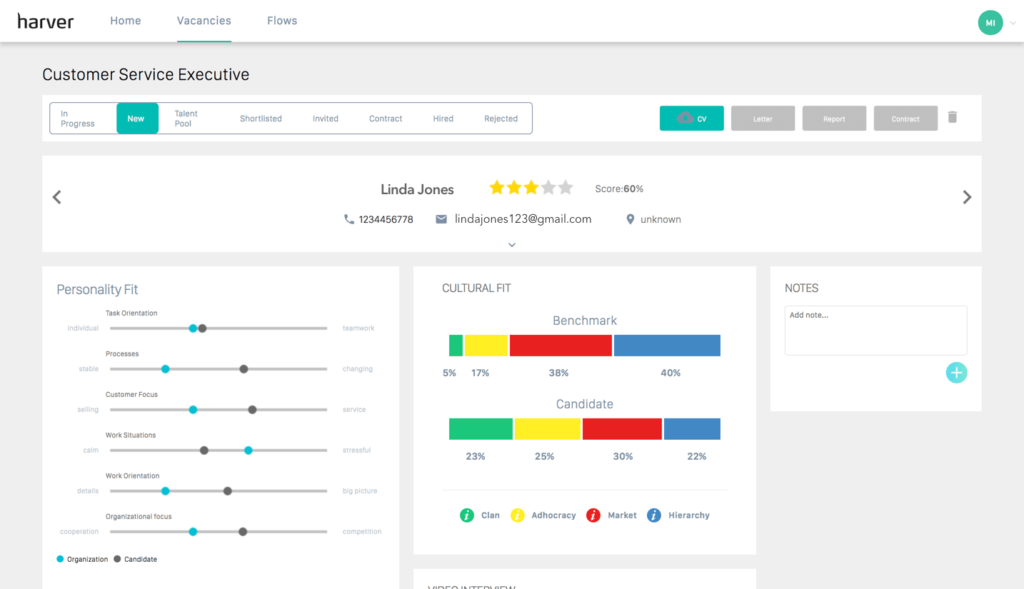
And for deeper screening, Harver creates skill and personality assessments. A resume can only tell you so much. You want to know if someone can do the work and whether they’ll mesh with the team.
But here’s what most people miss. You can have the best ATS in the world, and your hiring process will still break if nobody knows what happens after the offer letter goes out. That’s where onboarding comes in. And that’s where most companies drop the ball.
Onboarding done right changes everything
I probably sound like a broken record, but this stat keeps proving itself. research that strong onboarding improves new hire retention by 82%. Meanwhile, Jim Harter at Gallup reports that only 12% of employees strongly agree their company does onboarding well.
That gap is enormous. And it’s expensive. SHRM estimates replacing someone can cost 50% to 200% of their annual salary. For a $60,000 employee, that’s $30,000 to $120,000 in recruiting, training, and lost productivity. That’s not a rounding error.
Most companies wing it. New person shows up. Manager says “hey, welcome.” Someone eventually gets them a laptop. Maybe.
We built Tallyfy because we kept seeing this pattern hundreds of times. What nobody warned us about is that the ones who actually reduce early turnover are the ones who treat onboarding as a defined, trackable workflow. Not a checklist taped to a cubicle wall.
Here’s what a solid onboarding process looks like when you build it in Tallyfy:
- Employee accepts offer. Workflow triggers automatically.
- IT gets notified to set up accounts and equipment.
- HR sends compliance documents for digital signatures.
- Manager schedules first-week meetings.
- New hire gets training materials in the right sequence.
- Each step has a deadline. Nothing gets forgotten.
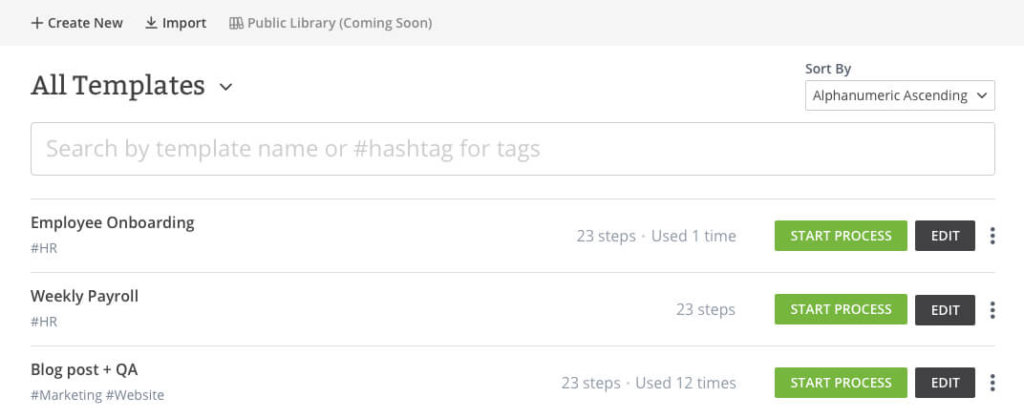
The difference between winging it and running a workflow isn’t marginal. It’s the difference between keeping someone for three years versus losing them in three months.
Tallyfy also handles approval workflows. Employee wants time off? They fill in a form, it routes to their manager, and the decision gets logged. No email chains. No sticky notes.
HR workflow templates you can use today
People management without the spreadsheet nightmare
Once someone’s hired and onboarded, there’s the day-to-day. Payroll. Benefits. Time tracking. Compliance. It adds up fast.
Zenefits (now TriNet HR Plus) tries to be the one-stop-shop for all of this. Time tracking, benefits administration, payroll, compliance. It’s not perfect, but it sort of covers a lot of ground.
- Automated onboarding
- Employee management
- Time off tracking
- Everything in Essentials
- Performance reviews
- 1-on-1 meeting tools
- Super-powered HR
- Payroll included
- Benefits administration
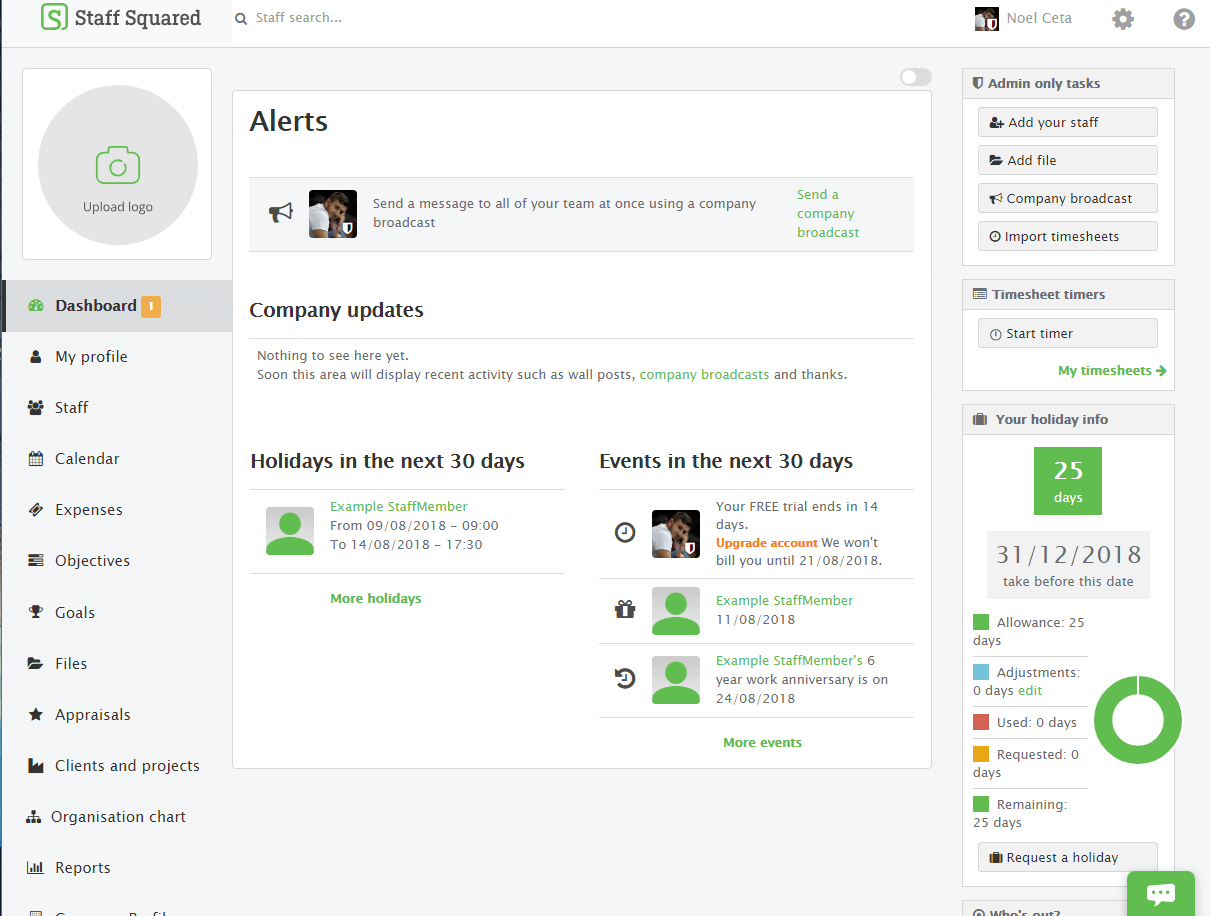
If Zenefits feels like overkill, StaffSquared handles the basics: absence management, expense tracking, time tracking, and reporting. It skips payroll and deep compliance features, so it’s simpler and cheaper.
My blunt take? Pick the one that matches your actual needs. Something I’ve noticed across industries - too many teams buy the expensive all-in-one suite and then only use it for time-off requests. That’s like buying a race car to drive to the grocery store.
Keeping people engaged after you hire them
Retention doesn’t stop at onboarding. People leave when they feel invisible. When good work goes unnoticed. When there’s no path forward. Can a tool fix all that? Not by itself.
Bonusly lets employees recognize each other with points that turn into real rewards. Free lunch, extra day off, gift cards. Everyone gets a monthly allowance to hand out. It plugs into Slack and Teams, so recognition happens where people already work.
- Up to 8 users
- Peer recognition
- Unlimited seats
- Advanced analytics
- SAML SSO
- Dedicated support
For feedback and goal-setting, Trakstar makes 360-degree evaluations and performance tracking less painful. Employees set goals. Managers track progress. Everyone gets feedback throughout the year instead of one terrifying annual review.
Expect sales calls and unpredictable costs. Hard to budget or compare.
See Tallyfy's transparent pricing insteadThe thing is, these tools matter because they create feedback loops. And feedback loops, when they’re built into a defined workflow, mean problems surface before someone quietly starts interviewing elsewhere.
Where AI agents fit into HR right now
I want to be direct about this. AI in HR is mostly hype right now. But there are real signals underneath.
IBM built AskHR, an AI tool that automates over 80 common HR processes. It resolves 10.1 million interactions a year, saving IBM 50,000 hours and $5 million annually.
That’s impressive. But notice something. IBM didn’t just throw an AI chatbot at their HR department. They defined 80+ processes first. Then they automated them. Process first, technology second.
AI agents can take real weight off HR admin. For routine transactions, forms, and reporting, they can handle a large share of the workflow. But the opportunity isn’t just efficiency. It’s freeing HR to do work that actually requires a human. Strategic workforce planning. Culture building. The stuff that makes people want to stay.
Based on feedback we’ve received at Tallyfy, the companies getting this right are the ones who start with process definition. They map out exactly what should happen at each step of hiring, onboarding, or performance management. Then they let AI handle the repetitive parts while humans handle the judgment calls.
The ones getting it wrong? They’re buying AI tools before they’ve even documented their onboarding process.
How to pick the right HR tools
I’ve watched teams evaluate HR software for months and still pick the wrong thing. Here’s how to avoid that.
Start with your biggest pain point. Is it hiring? Onboarding? Payroll? Don’t buy a suite when you need a scalpel.
Then ask: does this tool force me to define my process? If it just gives you a blank canvas with no structure, you’ll end up with the same chaos in a fancier interface. The best HR tools make you think about your workflow before you start using them. That constraint is a feature.
Finally, think about what happens between tools. The gap between your ATS and your onboarding system is where new hires get lost. The gap between your payroll system and your compliance tracker is where violations happen. Workflow tools bridge those gaps by turning janky handoffs into tracked steps.
Related questions
What are the most important HR tools for small businesses?
Start with three things. Something to track applicants, something to run onboarding workflows, and something for payroll. Don’t try to buy everything at once. A workflow tool handles the process side, letting you build onboarding, time-off requests, and approvals without writing code. Pair it with a payroll provider and you’re covered.
How can HR teams use AI without it backfiring?
Map your processes first. Every single one. Then identify the repetitive, rule-based tasks within those processes. Those are what AI agents handle well. Leave judgment calls, sensitive conversations, and exceptions to humans. The mistake is throwing AI at undefined work and expecting it to figure things out.
What does good employee onboarding look like?
It’s a defined sequence of steps with clear owners and deadlines. Not a welcome email and a prayer. Good onboarding covers paperwork, equipment setup, introductions, training, and early check-ins. Each step triggers the next. Nothing depends on someone remembering to do it. The whole thing should take 30-90 days depending on role complexity.
How do HR tools help with compliance?
They create audit trails. Every step completed, every document signed, every approval granted gets logged with timestamps. When an auditor asks “can you prove this employee completed safety training?” you don’t have to dig through email. You pull up the workflow and show them exactly when it happened and who verified it.
Which HR functions should you automate first?
Start with whatever eats the most hours. For most teams, that’s onboarding, time-off requests, and document approvals. These are high-volume, rule-based, and low-risk to automate. Save the complex stuff like performance management and compensation planning for later, once you’ve built the muscle of running workflows.
