
Workflow management vs business process management
Workflow management handles task sequences between people. Fortune Business Insights projects the BPM market will grow from $25.88 billion in 2026 to $91.87 billion by 2034 at 17.2% CAGR, driven by AI integration.
The gap between workflow management and process management trips up almost every team I talk to. Here’s the short version: workflow management defines who does what and in what order. Business process management looks at the whole operation and asks whether it should exist at all.
Business Process Management Made Easy
Summary
- Workflow is about people and task sequences, BPM is about end-to-end operations - Workflow management shows who does what and when. Business process management governs complete activity sets across departments, from design through monitoring and improvement
- Building an agent without a workflow is like hiring someone with no job description. But nobody’s building the workflows they need to follow - AI amplifies whatever process it touches. AI scales whatever you feed it - garbage process in, garbage results out. research over 40% of agentic AI projects will be canceled by 2027 because teams automated workflows that were already broken
- The BPM market is exploding because of AI - Fortune Business Insights projects the BPM market will grow from USD 25.88 billion in 2026 to USD 91.87 billion by 2034, a 17.2% CAGR driven by AI integration
- Pick the right approach for your goal - Need a clear map of who handles what? That’s workflow. Need to reduce costs, eliminate bottlenecks, and improve an entire operation? That’s BPM. Tallyfy handles both in one place. See how it works
What workflow management really means
Workflow management is tactical. It answers a simple question: who does what, and in what order?
A workflow diagram is usually pretty basic. It’s the minimum set of instructions someone needs to take action and hand off to the next person. Think of it as a relay race baton pass - the diagram shows when each runner starts, which lane they’re in, and where the handoff happens.
What matters most in workflow management is the people. Not the underlying process logic. Not the data flow. The people.

Here’s an example. A taxi booking workflow starts with a rider choosing phone or online. Phone goes to a live operator. Online goes to an agent portal. Both paths converge at the dispatch server, which assigns a driver. The workflow shows the path a person takes, not how the dispatch algorithm works.
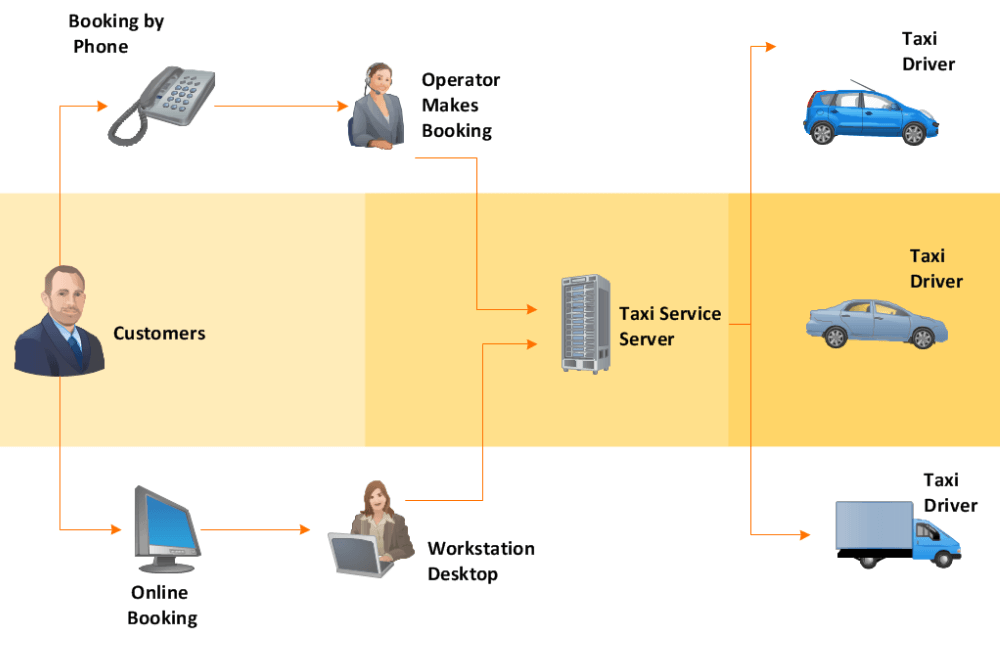
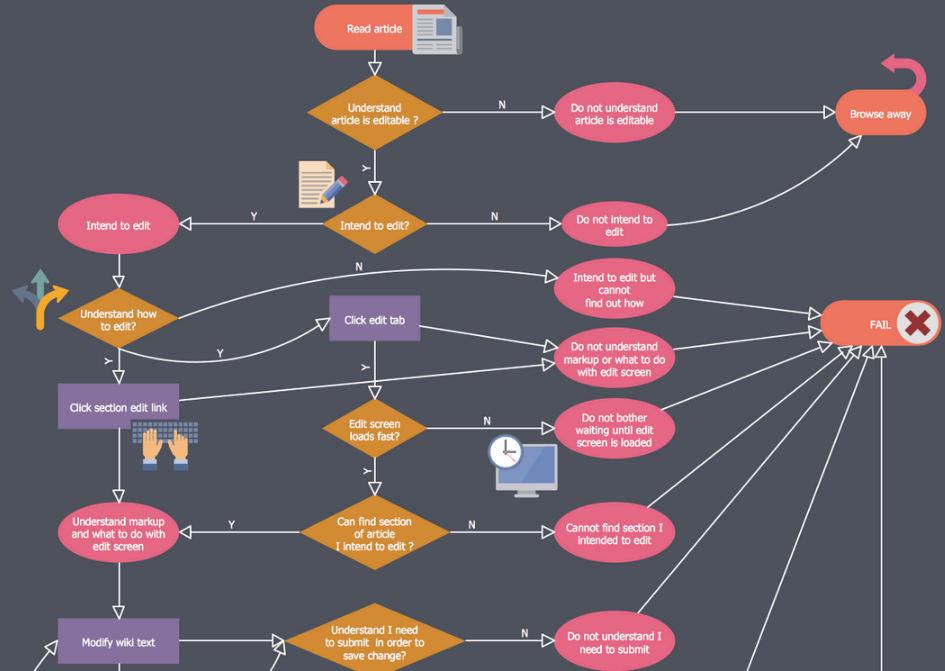
It’s not typically automated. The workflow just shows the structured path and the specific people involved at each stage. Another example of a workflow might be an editorial review process - read an article, decide if it needs edits, route it based on yes or no answers. People-centric tasks, every time.
Where do organizations use workflows most? Sales teams tracking different funnel stages across a portfolio. Customer service routing inquiries through different tiers. Manufacturing defining steps in a production line. Even high-level organizational workflows that show the 30,000-foot view from purchase orders through distribution.
The common thread? Workflows focus on individuals and departments. Not on the detailed processes underneath.
What business process management does differently
If workflows focus on people and their roles, business process management focuses on defining and improving the actual processes.
That’s a bigger job. A company using BPM would map out current processes from end to end - every action, every step, every phase. This can cover a specific project, a single department, or the entire organization.
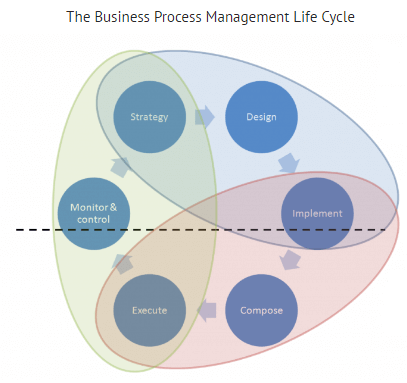
The initial process map reveals where things bottleneck and where efficiency breaks down. When matched with data, it shows exactly what to fix. One thing that keeps coming up in conversations with healthcare and financial services organizations is that without this visual mapping step, teams often automate the wrong parts of a process. One payment processing team discovered their bottleneck wasn’t data entry - it was manual approval handoffs that nobody had questioned for years.
In the manufacturing example from earlier, a workflow defines specific production line steps. BPM maps out detailed instructions for every step, then uses data to find the most critical bottlenecks and make that production line more efficient.
Are you hearing this at work? That's busywork
Enter between 1 and 150,000
Enter between 0.5 and 40
Enter between $10 and $1,000
Based on $30/hr x 4 hrs/wk
Your loss and waste is:
every week
What you are losing
Cash burned on busywork
per week in wasted wages
What you could have gained
160 extra hours could create:
per week in real and compounding value
Total cumulative impact over time (real cost + missed opportunities)
You are bleeding cash, annoying every employee and killing dreams.
It's a no brainer - improve your workflows
Is process chaos sustainable?
Here’s where I get frustrated. Most organizations I talk to are running on undocumented tribal knowledge. People know “how things work” because they’ve been there long enough to absorb it through osmosis. Then someone leaves, and suddenly nobody knows why step 4 exists or who approved that workaround three years ago.
Deloitte’s research on AI agents and business process automation found that leading enterprises don’t simply layer AI agents onto existing workflows. They redesign processes first. The ones who skip that step? They scale inefficiency faster.
This connects to something I think about constantly. AI agents can think three steps ahead on a board with no squares. Right now, nobody’s building the workflows those agents need to follow. A messy approval chain doesn’t get better when you add an AI agent. It just generates wrong approvals faster.
At Tallyfy, we’ve watched this play out across hundreds of implementations. The teams that document their processes before automating them get dramatically better results than the ones who rush to “add AI” to whatever chaos they’re currently running.
The real difference in practice
If your workflow is the playbook, then process management is the coach.
The playbook tells each player where to stand during a specific play. The coach has everything mapped out - who goes where, how they get there, what needs to happen to make each play work. The coach deploys plays efficiently, monitors execution, makes corrections, and keeps the whole team running.
Workflows organize people and sometimes resources and documents. Once created, a workflow gets followed like a map until someone decides a change is needed. It’s relatively static.
Business process management is ongoing. It’s the continuous monitoring and analysis of operations after they’ve been defined and deployed. Not just making sure the right person is on the right task - but asking whether the task should exist in the first place.
That said, workflows and BPM aren’t enemies. After watching hundreds of teams try this, I can tell you it’s common to create workflows that manage individual segments within larger processes. The distinction matters most when you’re trying to achieve a specific goal like reducing costs or improving efficiency.
Where BPM gets deployed
Virtually every business can benefit from process management - even a drop shipping operation can define processes for sourcing goods, listing products, fulfilling orders, and managing post-order engagement. Something I’ve noticed across industries is that the organizations that resist BPM the longest tend to need it the most. Hospitals have dozens of teams caring for patients, and the processes are complex with plenty of room for problems, so process management reduces inefficiencies and bottlenecks to improve quality of care. Banks and institutions like hedge funds use BPM to ensure each step is followed closely enough to comply with federal regulations - this showed up again and again during onboarding calls with financial services teams, where compliance documentation is consistently their biggest pain point. Design agencies working with multiple teams and contractors use process management to move projects from ideation through design, development, QA, review, and deployment, and approval processes alone can save hours per week. The pattern holds whether you’re running a 10-person creative shop or a 500-bed hospital. BPM forces you to look at the whole picture instead of just the piece directly in front of you. That shift in perspective is what separates teams that grow smoothly from teams that drown in their own complexity.
Why this matters more in the age of AI
I probably sound like a broken record, but this is the hill I’ll die on.
The BPM market is projected to nearly quadruple by 2034, largely because organizations are realizing that AI agents need structured workflow patterns to operate. Without sequential, parallel, and evaluation-loop patterns, AI agents are just chatbots with expensive compute bills.
research over 40% of agentic AI projects to be canceled by 2027. The reason? Organizations are automating workflows that were already broken. As iGrafx put it plainly: don’t automate chaos.
We designed Tallyfy specifically for this. Process definition and standardization isn’t just a nice-to-have anymore - it’s the baseline requirement before AI makes sense. You can’t hand an AI agent a process that lives in someone’s head. You need it documented, structured, and trackable. That’s the infrastructure piece everyone’s ignoring while they chase the shiny agent demos.
Which one do you pick?
If you need a detailed map of who does what in a specific sequence - that’s a workflow. If you need to map, monitor, improve, and scale entire operations - that’s BPM.
Most organizations need both, honestly. The workflow handles the tactical execution. The process management handles the strategic improvement. Tallyfy combines both approaches, which means you don’t have to choose between them or buy two different tools.
The question isn’t really “workflow or BPM?” anymore. It’s “do I have my processes defined well enough for AI to follow them?” If the answer is no, that’s where you start. Fix the process. Document the workflow. Then automate.
Related questions
What’s the difference between workflow management and business process management?
Think of them as cousins. Workflow management explains the natural sequence of tasks within a well-defined process - like following a recipe step by step. BPM takes a wider view. It examines every recipe in the kitchen and figures out the best way to run the entire bakery smoothly. BPM looks at how different processes work together to improve overall organizational performance.
How’s a business process flow different from a workflow?
Imagine a road trip. A workflow is the turn-by-turn directions for one specific route. A business process flow is the map of the entire highway system - it shows how different pathways connect and relate, giving you an overview of all potential routes. A workflow follows a specific order. A business process flow can show how multiple workflows interact as part of a bigger goal.
What’s the difference between BPA and workflow?
BPA (Business Process Automation) and workflow are two different tools in the same toolbox. A workflow is your checklist - it walks you through steps and keeps you on track. BPA is closer to a system that doesn’t just follow the checklist but also decides and acts. It uses technology to handle tasks that are repetitive, error-prone, or just time-consuming. Where workflow shows you the path, BPA walks it for you.
What’s BPM and workflow?
BPM and workflow are complementary. The workflow is the rulebook - it tells you what steps to take to complete a task. BPM is the coach watching every game in the league. It observes how different workflows interact, finds bottlenecks, and develops ideas for better overall performance. Workflow handles individual process efficiency. BPM makes sure all processes work together toward higher-level business goals. Both together make a strong team.
Templates that show the difference
Use this form to submit a vendor invoice for payment. Provide complete vendor and invoice details to
About the Author
Amit is the CEO of Tallyfy. He is a workflow expert and specializes in process automation and the next generation of business process management in the post-flowchart age. He has decades of consulting experience in task and workflow automation, continuous improvement (all the flavors) and AI-driven workflows for small and large companies. Amit did a Computer Science degree at the University of Bath and moved from the UK to St. Louis, MO in 2014. He loves watching American robins and their nesting behaviors!
Follow Amit on his website, LinkedIn, Facebook, Reddit, X (Twitter) or YouTube.

Automate your workflows with Tallyfy
Stop chasing status updates. Track and automate your processes in one place.