
Process improvement is about making things more effective, not just efficient. Here’s how we approach process improvement.
Summary
- Effectiveness beats efficiency every time - A process can be blazing fast and still produce the wrong outcome. Fix what you’re doing before you speed up how you do it
- Six Sigma targets 99.9966% quality - The DMAIC method digs into root causes of defects and variation, not surface symptoms. Manufacturing case studies show rejection rates fell from 7.5% to under 2%
- Cross-training your people prevents single points of failure - One sick day from a key person shouldn’t grind your operation to a halt. Monthly rotation programs build resilience
- AI won’t rescue a broken process - It’ll just break it faster. ASQ resources confirm that AI amplifies whatever you already have, good or bad. See how Tallyfy helps you fix processes before you scale them
Tallyfy is Process Improvement Made Easy
A business process is a string of activities - usually performed by a group of people, sometimes just one - that aim to hit specific goals.
Most companies jump straight to making these processes faster. Cut time. Cut cost. Speed everything up. But speed without direction is basically expensive chaos.
I think we have to notice that the business processes we use right now for thinking and planning and budgeting and strategy are all delivered on very tight agendas.
Margaret J. Wheatley
The goal isn’t efficiency. It’s effectiveness. Because a highly efficient process that produces the wrong result is still a failure. I’ve watched teams fine-tune workflows for months only to realize they were perfecting something that shouldn’t exist in the first place.

Why effectiveness comes before efficiency
Companies that focus on delivering value before streamlining operations tend to pull ahead of their peers. That’s not a small edge. That’s the difference between leaders and everyone else.
Here’s what process improvement looks like when you get the order spot on.
Cost cutting through visibility - Restructure your processes so you can see them. Visualize them. When you do, redundancies jump out at you. Unnecessary steps become obvious. One of our early discoveries at Tallyfy was that most teams don’t have a cost problem - they have a visibility problem. They’re paying for work they can’t see, so they can’t fix it.
Fixing communication gaps - This one drives me crazy. A process breaks because someone didn’t get an email. Or got the wrong email. Or got twelve emails and missed the important one. Telling people to “communicate better” is meaningless advice. Real solutions come from process modeling that removes email from the equation. Put the information where people already work instead of making them hunt for it.
Process visualization for ongoing auditing - You can’t improve what you can’t see. Visualization lets you follow a process and spot bottlenecks as they form - not after they’ve caused a three-day delay. Something I’ve noticed across industries: teams who map their processes visually catch problems roughly three times faster than teams stuck with tribal knowledge and email chains.
Proven methods that work
There are three well-established approaches worth understanding. Each tackles process improvement from a different angle, and most organizations benefit from borrowing ideas across all three.
LEAN - built on what people value
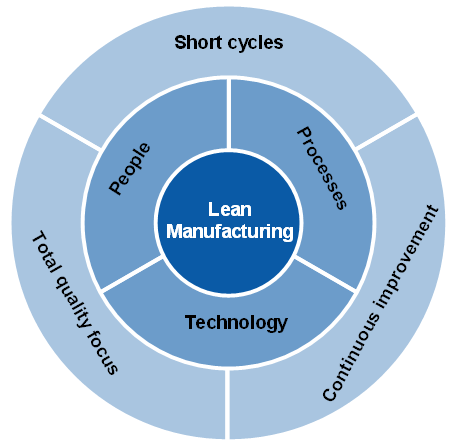
LEAN manufacturing originated with Toyota. Taiichi Ohno and Eiji Toyoda developed the Toyota Production System between 1948 and 1975, and it’s still the gold standard for waste elimination.
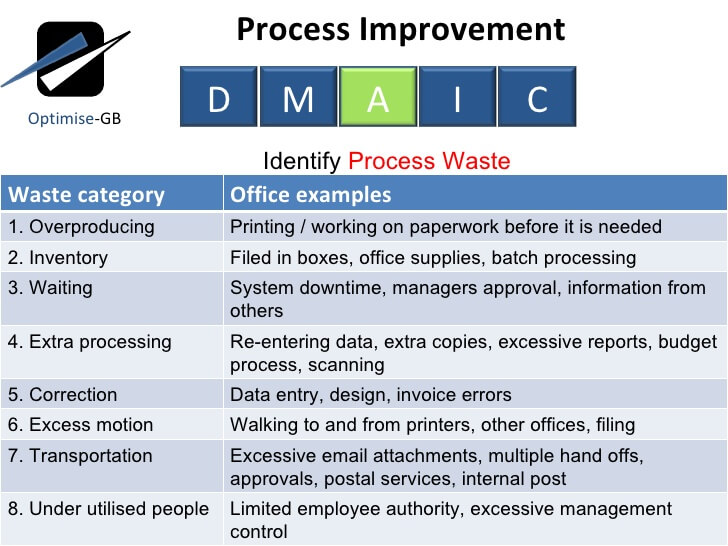
The core idea? Figure out what people value from your product. Then ruthlessly cut everything else. Toyota identified seven categories of waste - from overproduction to unnecessary motion to excess inventory. Later contributors added an eighth: underutilized employee skills.
What I find fascinating about LEAN is the philosophy underneath it. It’s not top-down mandates from consultants. It’s built on kaizen - small, continuous improvements driven by the people who do the work. That’s the opposite of how most companies approach process improvement, which usually involves expensive consultants and sweeping reorganizations. Running Tallyfy taught us that these small, team-driven improvements compound faster than any big-bang overhaul.
Six Sigma and DMAIC
Six Sigma targets a quality level of 99.9966% - near-perfect output. That sounds abstract until you see real numbers.
The DMAIC method (Define, Measure, Analyze, Improve, Control) provides the structure. A manufacturing case study published in Heliyon showed crankshaft rejection rates dropped from 3.04% to 1.88% after DMAIC implementation. That reduction was statistically significant - not random variation, but genuine improvement confirmed through chi-squared testing. Numbers like that are hard to argue with.
In healthcare, Six Sigma has been used to reduce radiology wait times and decrease unnecessary antibiotic use. The method works across industries because it attacks root causes, not symptoms.
Total Quality Management
Six Sigma is the newer kid on the block. The older approach, Total Quality Management, was crafted by W. Edwards Deming and Joseph Juran - best known for the process improvements they brought to automotive manufacturing in Japan.
Like Six Sigma, TQM focuses on eliminating errors. But it places more emphasis on organizational culture and employee involvement. The distinction matters because you can have a perfect method and still fail if your people aren’t bought in.
One piece at a time beats batching
At Tallyfy, we’ve seen something sort of counterintuitive that trips up most operations teams: processing work in batches feels efficient but usually isn’t. To be fair, batching works fine for some things. Moving one item all the way through all stages before starting the next often beats accumulating piles at each step.
Think about invoice processing. The batch approach says collect fifty invoices, then approve them all, then code them all, then pay them all. Looks organized on paper. In practice, errors discovered late require painful rework on the entire batch.
The one-at-a-time approach catches problems immediately. You fix one invoice fully before touching the next. Total throughput goes up because you’re not shuffling papers multiple times or tracking down context you’ve already forgotten. Manufacturing figured this out decades ago. Knowledge work hasn’t caught up yet.
AI follows whatever process you give it, including the broken one
This is the mega trend I keep coming back to. Everyone’s rushing to bolt AI onto their operations. But ASQ resources confirm what we’ve observed firsthand: AI doesn’t fix broken processes. It amplifies them.
If your workflows are fragmented or cobbled together, AI will accelerate the confusion, not the impact.
Think about it this way. A broken process handled manually produces maybe ten mistakes a day. Automate that same broken process with AI and you get ten thousand mistakes a day. Faster. More confidently wrong. Does automation fix everything? Not even close.
Only a minority of organizations successfully scale their digital improvements. The rest see initial gains that fade because they lack the operational foundation to sustain them. Turns out, that’s the whole reason Tallyfy exists - process definition and structure have to come first, before any automation layer.
What busywork costs your company
per week
per year
over 5 years
Don’t avoid AI. Just get your processes right first. Document them. Standardize them. Then automate. That sequence matters more than which AI tool you pick.
Building a culture of continuous improvement
Process improvement isn’t a one-and-done project. It’s an ongoing discipline. Here’s what continuous improvement looks like in practice.
Focused improvement sprints - Pull together the right people, clear their calendars for a week, and do nothing but dissect one specific process problem. No distractions, no other meetings. What surprised us when we dug into the data is that professional services firms who’ve tried this approach see dramatic results - teams running half-day sessions focused on their intake process had mapped every delay point and assigned owners to fix them by lunch. Three months of “we should really look at this” solved before dinner.
Time audits with real measurement - Set measurable benchmarks so you can track how long specific tasks take. Don’t rely on self-reporting - have someone observe and record. Once you have the data, you can establish realistic standards. Without measurement, you’re just guessing.
Cross-training to prevent bottlenecks - When you cross-train employees to work in multiple positions, you protect your processes from the inevitable disruptions that come from people-centric operations. A sick day shouldn’t break your workflow. Research shows cross-training improves both individual and team performance and cuts bottleneck load.
Surveying the people who do the work - The people inside your processes know exactly where errors happen and what could be fixed. Frontline workers provide insights into bottlenecks and inefficiencies that no outside consultant would catch. The pattern we keep running into is that organizations who survey regularly catch problems before they become crises.
Introduce surveys for your vendors, employees, and key people. Ask them three things: what’s working, what’s broken, and what would they change first? Take that data at regular intervals and score how previous changes performed.
Related questions
What is considered a process improvement?
It’s figuring out smarter, faster, or cheaper ways of doing things. Sometimes it’s small - rearranging a workspace or adding a single tool. Sometimes it’s a complete rethink of how a team operates.
From feedback we’ve received, the small changes usually compound faster than the big ones. A pharmaceutical company identified six specific problems with their existing approach - ownership gaps, missed reminders, unclear review processes, scattered email submissions, limited collaborator access, and lack of real-time updates. Each small fix built on the previous one.
What are the four areas of process improvement?
Think of it as a four-part puzzle. Efficiency - using less time and fewer resources. Quality - reducing errors and defects. Satisfaction - keeping the people who use your output happy. Cost - spending less without cutting corners.
These four work together. Improve efficiency and you often get higher quality. Higher quality leads to happier people. Happier people stick around, which reduces costs. You’re solving four problems with one effort.
What is an example of a process improvement goal?
Say you run a pizza place. A solid process improvement goal: “Reduce delivery time by 20% within 90 days without sacrificing pizza quality.” That goal is specific, measurable, achievable, relevant, and time-bound.
How? Rearrange the kitchen layout. Train staff on faster prep techniques. Improve delivery routes. The beauty of a well-defined goal is that achieving it creates cascading benefits - happier people ordering from you, lower costs per delivery, and probably more orders because word gets around.
