
Summary
- These are developer SDKs, not ops tools - LangGraph, CrewAI, and AutoGen are code libraries engineers use to build AI agents. Nobody on an operations team will ever open one, and that single fact should reshape how you evaluate them.
- Which one is which? LangGraph models an agent as a graph of steps with explicit state. CrewAI organizes role-based agent teams inside event-driven flows. AutoGen, Microsoft’s multi-agent framework, now sits in maintenance mode per its own README.
- Churn is the headline risk - a framework with roughly 59,000 GitHub stars stopped getting new features. Your business processes will outlive whichever SDK engineering picks this quarter, so anchor AI projects to the process, never the framework.
- Tallyfy lives one layer up - agents built on any of these can call our MCP tools from inside a defined workflow. Worth a look if you’re scoping this: how AI steps run inside Tallyfy processes.
Workflow Automation Software Made Easy & Simple
You will never open LangGraph. Neither will anyone on your operations team. LangGraph, CrewAI, and AutoGen are developer SDKs - code libraries engineers import to build AI agents - and that’s the most useful fact about them. You don’t evaluate these the way you’d evaluate software your team works in, because nobody outside engineering ever touches them. You evaluate what gets built on top of them, the way you’d judge a building rather than the scaffolding it went up with.
That distinction sounds obvious and still gets ignored weekly. Agent frameworks keep appearing in board decks as things a company “adopts,” when they sit a full layer below anything the business runs - closer to a web framework than to any tool an ops person would recognize. Getting the layering straight is a decent chunk of how the agent era changes operations work, so this post does three things: explains what each framework is, reads Microsoft’s AutoGen decision for the churn warning it carries, and locates the business-process layer - the one you own - on top of all three.
What do these frameworks actually do?
LangGraph comes from the LangChain team and describes itself as an agent runtime and low-level orchestration framework. Strip the vocabulary and it’s a way to define an agent as a graph: discrete steps, explicit transitions between them, and a state object that survives the whole run. Sagi Medina, who picked it for Qodo’s coding agent in March 2025, put it concretely: “At its core, LangGraph lets you define a state machine for your agent. You create nodes that represent discrete steps in your workflow and edges that define the possible transitions between them.” It ships controls that let people steer and approve agent actions mid-run, and its marketing page wears logos from Klarna, Lyft, and LinkedIn. Engineers reach for it when they want control over every transition more than they want speed to a first demo.
The discussion among people who use these tools daily is worth a listen, mostly for where their vocabulary goes. When the Qodo post reached Hacker News in March 2025, submitted by jimminyx, a commenter called leopoldj drew the line this whole post is built around: “LangGraph is different. It is a legitimate piece of workflow software and not a wrapper framework. Now, when it comes to workflow there are many other well established engines out there that I will consider first.” Another commenter, nfcampos, described its engine as a Pregel variant orchestrating “workflows with cycles” and “parallelism without data races,” and a third, jeffspinny, called it a state machine framework for human-in-the-loop work. Hand engineers an agent framework and they reach for workflow vocabulary within two comments. Hold onto that - it comes back at the end.
CrewAI bills itself as the leading open-source framework for orchestrating autonomous AI agents - their words. Its mental model is roles rather than graphs. You define a crew - say, a researcher, a drafter, and a reviewer - and delegate a task to the team. The detail an ops reader should catch sits one level up in their own docs: crews are meant to live inside Flows, which CrewAI describes as “structured, event-driven workflows that manage state and control execution,” with a crew reserved for the moments where a team of agents needs to handle one specific, complex task. Read that twice. Even the framework famous for agent autonomy wraps that autonomy in a deterministic workflow before trusting the output. Faster to prototype with than LangGraph, less control over each transition - that’s the trade nearly every side-by-side lands on.
AutoGen is Microsoft’s entry. Its README calls it “a framework for creating multi-agent AI applications that can act autonomously or work alongside humans,” and it collected roughly 59,000 GitHub stars along the way. It’s also in maintenance mode now, by Microsoft’s own notice - and how that happened deserves its own section, because it’s the part with an operations lesson inside.
Expect churn at the framework layer
The warning sits at the top of AutoGen’s GitHub README in plain text: “AutoGen is now in maintenance mode. It will not receive new features or enhancements and is community managed going forward.” New users get pointed at Microsoft Agent Framework, billed in the same README as the enterprise-ready successor. So a framework with tens of thousands of stars, Microsoft’s name on the repo, and a large community wound down active development - and nothing failed: no scandal, no outage, just strategy shifting the way strategy does. A February 2026 comparison from OpenAgents - itself a framework vendor, so salt accordingly - reads the consequence plainly: bug fixes and security patches continue, major new features probably don’t. If your company had spent a year building its agent on AutoGen, none of that would be wrong, exactly. It would just be your problem.
What happens to the agent your team built when its framework goes into maintenance mode?
Nothing dramatic, at first. The agent keeps running. Then a model API changes shape, or a security review demands a patched dependency, and “community managed” turns out to mean a migration project nobody budgeted. The week that lands, the framework decision your engineers made in an afternoon becomes a line item you own for two quarters - a messy one, because now you cobble together a swap plan after the fact instead of designing it in.
What surprised us more than it should have: the questions we field about agent stacks rarely center on model capability. Operations people ask about exactly this - what survives a framework reshuffle, who maintains the thing in year two, how much work moves when a vendor pivots.
Engineers benchmark; operators amortize.
The durable answer is to anchor the project one layer up. Vendor intake was vendor intake before any of these frameworks existed, and it will still be vendor intake after two of the three have merged into something else. That’s the heart of the case for deploying workflows rather than agents: the process is the stable unit, and the framework is an implementation detail your engineers should be free to swap without renegotiating the business.
The hedge costs almost nothing if you set it up early. Keep the agent’s job description - what it reads, what it must produce, what it must never touch, where it escalates - in the process layer, written where the people who own the outcome can read it. Do that, and a framework migration hands the new agent a spec. Skip it, and the migration starts with an archaeology project through a departed engineer’s code to figure out what the old agent was actually doing.
Side by side, for people who run operations
Engineers comparing these three argue about graph semantics and callback APIs. From an operations chair, different columns matter: who works in the thing, what happens to state, and what the project’s status signals about its future. Here’s the comparison stripped to those, deliberately free of benchmark scores and pricing - both go stale faster than this post will, and benchmark tasks rarely resemble the work your business actually runs.
| Three agent frameworks, an operator's view | |||
|---|---|---|---|
| LangGraph | CrewAI | AutoGen | |
| Core abstraction | A graph of steps with explicit, durable state | Role-based crews working inside event-driven flows | Multi-agent applications, autonomous or human-paired |
| Self-description | Agent runtime and low-level orchestration framework | Leading open-source framework for orchestrating autonomous AI agents | A programming framework for agentic AI |
| Strongest fit | Control over complex, stateful execution | Fast multi-agent prototyping | Teams already running it |
| Who works in it | Software engineers | Software engineers | Software engineers |
| Status signal | Active development | Active development | Maintenance mode; successor is Microsoft Agent Framework |
One row in that table does the most work, and it’s the repetitive one. Whoever wins the framework argument, the people inside the tool are software engineers, which means the agent’s behavior, its boundaries, and its definition of the work all live in code your operations team can’t read or change. No knock on the frameworks there - it just means the process those agents serve has to be defined somewhere the people who own the outcome can see it. The status row matters for the opposite reason: it’s the one cell that changes without anyone in your company doing anything, and AutoGen’s entry looked like the other two until it didn’t. Read the table as a translation aid for the next engineering proposal rather than a scorecard, because the right pick really does depend on what’s being built.
The wider tool map deserves one picture, because the categories are blurring - agent SDKs, workflow engines, project tools, and BPM suites all claim some version of “orchestration” now. Here’s where we place Tallyfy in it.
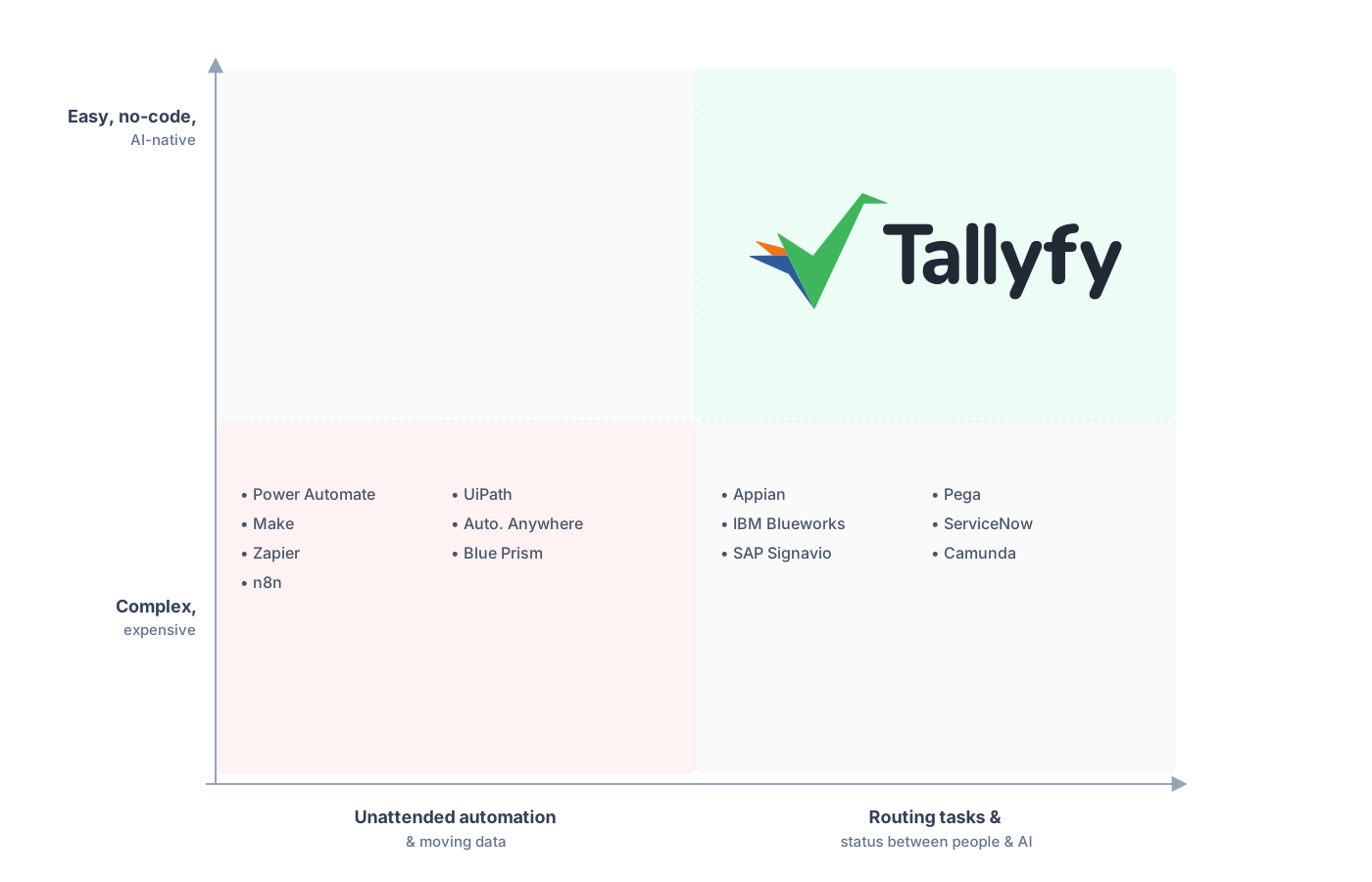
Where Tallyfy sits across tool categories: repeatable business workflows that people and AI run together.
Where Tallyfy sits in this stack
The plain answer: Tallyfy doesn’t compete with any of these, and pretending otherwise would be convenient marketing and bad advice. LangGraph, CrewAI, and AutoGen are what engineers build agents with. Tallyfy is the layer the work lives in - the documented, trackable business process that says what step three is, who approves step four, and what finished means. An agent built on LangGraph doesn’t replace your onboarding workflow. It applies for a job inside it.
The mechanics are concrete. Agents connect to Tallyfy through our MCP server, which exposes 100+ tools, and a step in a process can be assigned to an AI the same way it’s assigned to a person - same deadline, same audit trail, same approval gate after it. An agent built on any of the three frameworks picks up the step, does the bounded reading or drafting the step asks for, and hands back a result the process records. The AI steps pulling real weight today are narrow ones: reading and extracting, classifying and routing, drafting for a person to approve. That’s still early-stage across the whole industry, and narrow is fine - narrow is what reliable looks like, since reliability collapses as autonomous steps multiply no matter which framework is underneath.
The framework never meets your customer.
What your customer experiences is the process - the speed of the approval, the accuracy of the document, the handoff that did or didn’t happen - and that process needs to be written explicitly enough for a reader with no context, which is its own discipline and applies to agents from every framework equally. Meanwhile the deterministic branches - routing above a spend threshold, escalating by region - belong in rule-based automations that never needed a model in the first place.
Take contract renewals as a concrete case. A renewals process might have an AI step read each incoming contract and pull out the renewal date, the notice window, and the auto-renew clause into structured fields. A rule routes anything above a value threshold to a senior account owner, and a person makes the actual renegotiate-or-let-ride call. Whether the extraction agent was built on LangGraph or CrewAI changes nothing about that design - the process defines what gets extracted, where it lands, and who acts on it. Engineering could swap the framework over a weekend and the renewals team wouldn’t notice on Monday.
That said, the layers do touch, and the touchpoint matters. If your engineers build a LangGraph agent that drafts contract summaries, the questions of which contracts, triggered when, reviewed by whom, and recorded where are all process questions. Answer them in a defined workflow and the agent becomes a step you can measure. Leave them in the agent’s code and you’ve buried operational policy somewhere operations can’t see it.
Picking one without betting the company
A question we keep getting from teams comparing these frameworks: which one should we standardize on? That’s usually the wrong question, or at least the wrong owner - it’s an engineering call, the same way your Postgres version is. The operations questions sit elsewhere, and they’re the ones that decide whether the project survives contact with reality.
Say engineering proposes a LangGraph build for claims intake. Four questions belong at that table. First: which named workflow will this agent operate inside, and who owns that workflow’s cycle time? An agent with no process address is a research project. Second: if LangGraph follows AutoGen into maintenance mode in eighteen months, what’s the swap cost - does the agent’s job description exist anywhere outside the code? Third: where are the human gates, and were they placed by risk or by accident? Fourth: what exactly can the agent see and touch - which tools, which records, which systems?
Notice that none of those are framework questions. They’re process questions, every one of them, and that’s the pattern this whole comparison keeps pointing back to.
Play the claims example forward and the stakes get concrete. Intake at a mid-size insurer might run five steps: a claim arrives through a form, documents get checked for completeness, the claim gets classified by type and severity, an adjuster gets assigned, and the claimant receives a first-contact message inside the promised service window. The LangGraph proposal covers two of those five - classification, and drafting the first-contact message. Both are bounded, judgment-flavored, and checkable against a spec, so that’s a sensible place for a model. The other three steps stay exactly as they are. Framed that way, the project shrinks from “rebuild intake around an agent” to “upgrade steps three and five,” the budget discussion takes twenty minutes, and if the framework underneath ever has its AutoGen moment, two steps get re-implemented while the other three never notice.
Teams with defined processes can answer all four in an afternoon, which makes the framework choice low-stakes - the process is portable across frameworks, so engineering can pick whatever fits and revisit later. Teams without defined processes end up encoding business logic directly into agent code, where it hardens into something only one developer understands. Then the framework churns, and the migration drags the business logic with it. The expensive part was never the SDK. It was letting the SDK become the only place your process existed.
So let engineering read the graph-versus-crews debates and pick - it sort of doesn’t matter which one, and that’s the point. And recall where the engineers themselves went when they argued about LangGraph: straight to workflow vocabulary, state and steps and transitions. They were telling you which layer matters. Spend your own attention there, one layer up, on the part you can read: document the workflow, define each step, place the gates where mistakes cost real money. That work transfers across every framework cycle. The frameworks, on current form, won’t return the favor.
